


The complete guide
How to Choose a High Loft Latex Pillow
The problem with pillows that are too flat
Most people do not go looking for a tall pillow. They end up there after months of annoyance. You lie on your side, your head drops too low, and you wake up stiff. So you fold the pillow in half. Then you add a second one. Then you try a towel underneath. None of it stays put through the night, and by about 3am the stack has slid sideways and you are back where you started.
The reason is simple geometry. When you lie on your side, your head sits out at the width of your shoulder. That gap has to be filled by something, and if your shoulders are broad, or your mattress is firm enough that your shoulder does not sink into it, the gap is bigger than an average pillow was built to fill. A standard bed pillow is usually somewhere around 10 to 14 cm when it is new, and less than that after a year of use.
This pillow starts at 18 cm. It is not trying to be a general purpose pillow. It exists for the people who have already worked out that regular pillows leave them short.
How a latex core actually behaves
Latex is worth understanding before you buy, because it does not feel like the two fills most of us have slept on.
Polyester fibre is cheap and soft, and it compacts. Over a few months it packs down into a thinner, lumpier version of itself and you buy another one. Memory foam is the opposite problem for some people. It reacts to body heat, so it slowly softens where your head rests and holds that shape. Some sleepers love the cradled feel. Others describe it as being stuck in a dent and having to fight their way out every time they turn over.
Latex sits apart from both. It is springy. Press your hand into it and it pushes back straight away, and when you lift your hand the surface is flat again. That means the pillow follows you when you move rather than lagging behind. It also means the loft does not quietly disappear in the first few weeks the way fibre fill does.
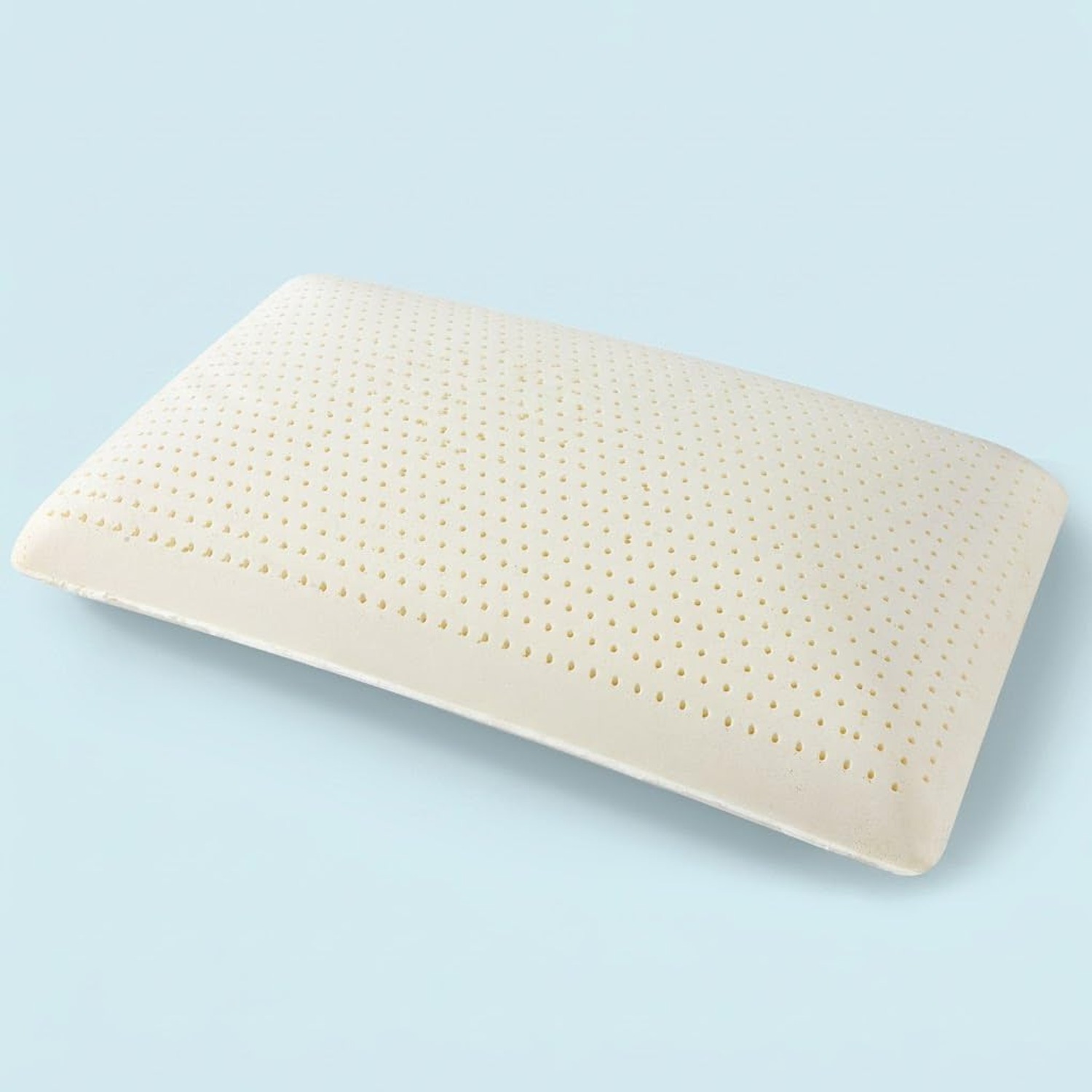
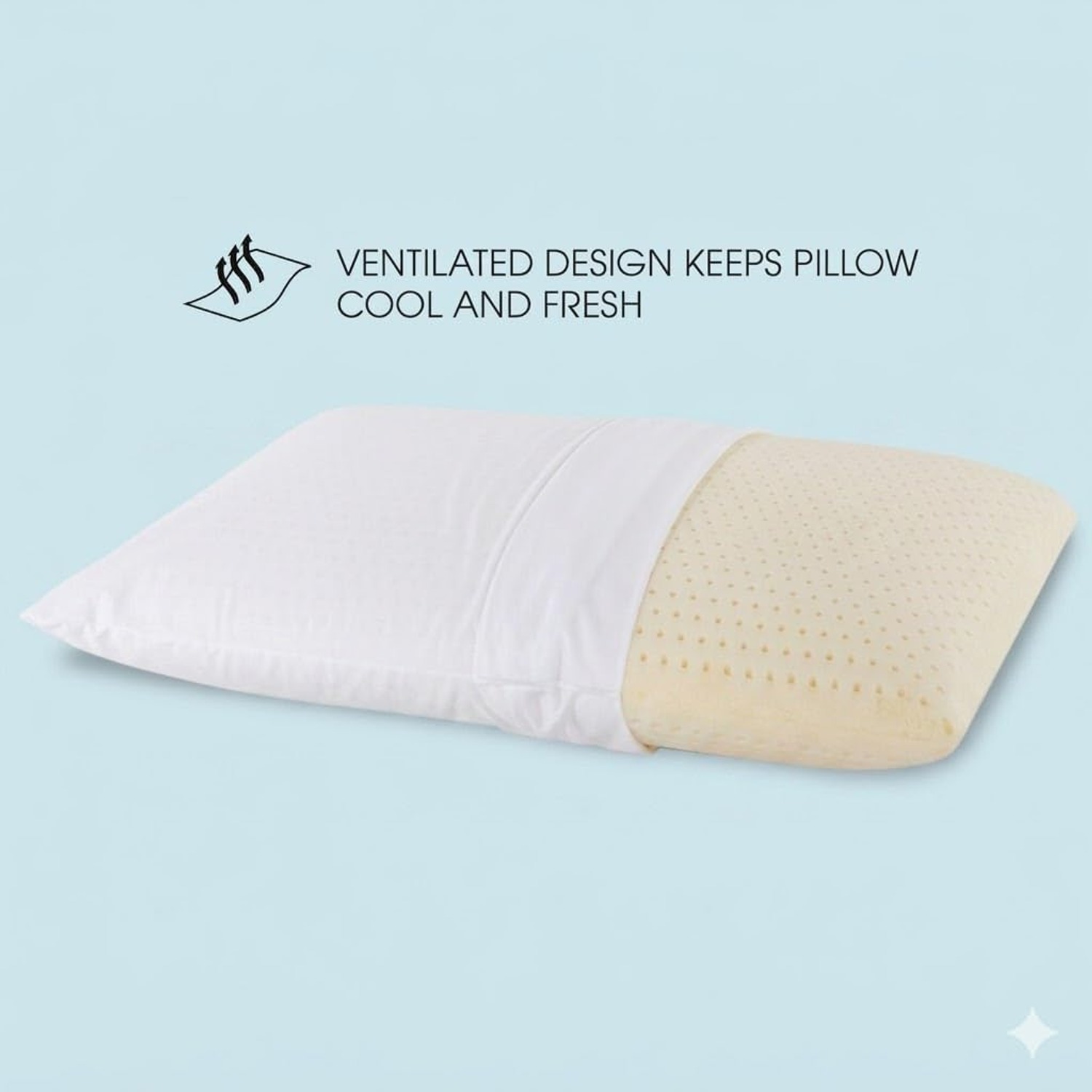
The core here is built with an open honeycomb structure rather than being a solid block. Those openings do two jobs. They soften the feel, which is part of why the firmness is listed as soft despite the pillow being tall. They also give air somewhere to move. A solid slab of any foam holds warmth. A structure with channels through it does not hold it in the same way.
Why the length matters as much as the height
A lot of people shopping for a tall pillow focus only on the thickness number and ignore the footprint. That is a mistake.
If you put a high loft on a short pillow, you end up sleeping on a block. Roll a few centimetres in either direction and you are at the edge, where the loft drops away sharply. You wake up because your head has slipped off the high part.
This one is 85 x 40 cm, which is a king length. There is room to turn over, shift position and settle again without hunting for the middle. If you share a king bed, two of these across the top also look right, where two standard pillows leave gaps at the sides.
The practical catch is bedding. An 85 cm pillow will not go into a standard case, which is normally around 48 by 74 cm. You need a king pillowcase, and ideally one with a bit of give to it, because an 18 cm loft takes up more case than a flat pillow does. Check your linen cupboard before the pillow arrives rather than after.
Working out whether the height suits you
Here is the simplest test. Lie on your side on your own mattress, in the position you usually sleep in, with your current pillow pulled out of the way. Get someone to measure the gap between the side of your neck and the mattress surface, or rest a ruler against your shoulder and eyeball it.
That gap is roughly what you want the pillow to fill, allowing a little for the pillow compressing under your head's weight. If that measurement comes in around 14 to 17 cm, a tall pillow like this is likely to work for you. If it comes in under 10 cm, you will find 18 cm too high and you should be shopping for a lower loft instead.
Two other factors shift the answer. A soft mattress lets your shoulder sink in, which closes the gap and means you need less pillow. A firm mattress holds your shoulder up and opens the gap, which means you need more. And if you sleep mostly on your back, the gap is smaller than it is on your side, because your head is nearer the bed.
The maker's description names stomach sleepers as a recommended use. Be honest with yourself there. Plenty of stomach sleepers prefer something quite thin so their head is not turned up at an angle. If you sleep face down and have always reached for the flattest pillow in the house, a high loft is probably not the direction to go.
Living with it day to day
The care routine for latex is short but it is not optional.
Rule one, the core never gets washed. Do not put it in a machine, do not soak it, do not take it in the shower. If something spills, use a damp cloth with a touch of mild soap, work gently on the spot, and then let it dry fully in a shaded room with air moving through it.
Rule two, keep it out of the sun. This catches people out, because airing a pillow on the line feels like the sensible thing to do. UV light breaks natural latex down. First it goes hard, then it starts to crumble at the edges. Shade and airflow are what you want, not sunshine.
The cotton cover is the part that does the regular cleaning work. It unzips, goes in the machine on a cold gentle cycle, tumble dries low, and no bleach. Adding a pillow protector underneath your pillowcase gives you another washable layer, which is a good habit with any pillow whose core cannot be laundered.
One more thing worth knowing. Natural latex often carries a faint natural scent straight out of the packaging. It is not a fault. Leave the pillow out in a well ventilated room for a day or two and it settles down.
Who should skip this one
It is only fair to say who this does not suit.
If you are happy on a thin pillow, this will feel like sleeping on a kerb. If you have a diagnosed latex allergy, do not use a latex product at all. If you want something you can throw in the wash whole, a fibre pillow is the easier choice. And if you mostly sleep on your back on a soft mattress, the geometry works against a tall pillow.
That is not a knock on the product. Pillows are one of the few bits of bedding where the right answer is genuinely different person to person, and a tall pillow bought by someone who needed a short one is just a bad night's sleep in a box.
The short version
This is a king length latex pillow, 85 x 40 cm, standing 18 cm tall, with a soft feel and a removable cotton cover. The core is natural latex with an open honeycomb structure, and it weighs 1.4 kg. It is aimed squarely at people whose shoulders need more height than an average pillow gives them.
Measure your shoulder to head gap before you order. Make sure you have king pillowcases. Keep the core dry and out of the sun, wash the cover instead, and air it for a day or two when it first arrives. If the height turns out to be wrong for you, talk to us and we will sort out the next step.